

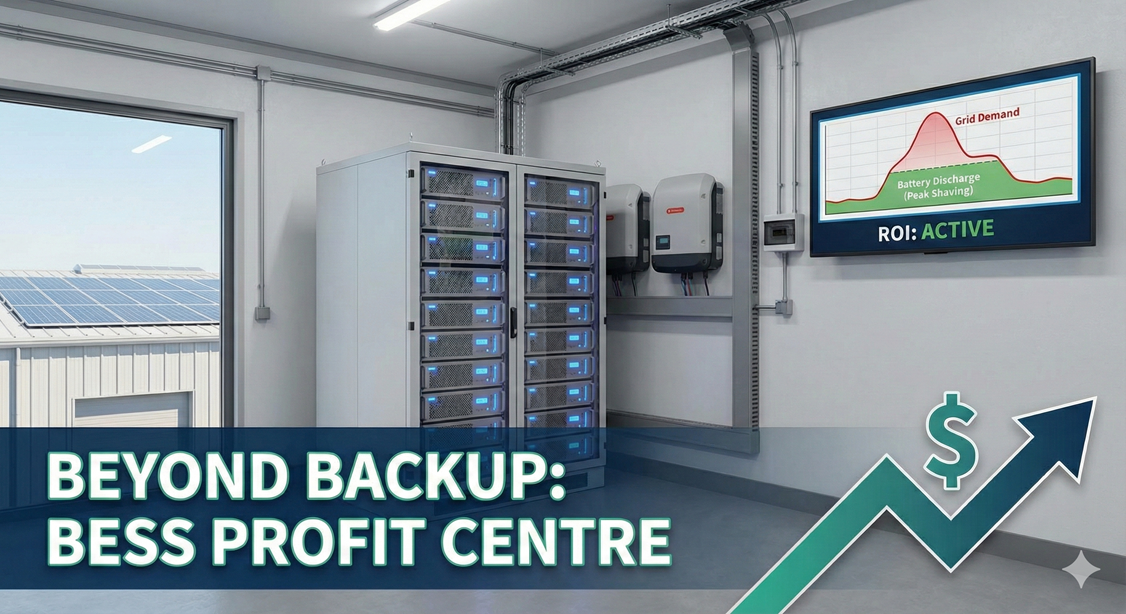
For many South African industrial businesses, investing in a Battery Energy Storage System (BESS) starts as a grudge purchase. It is often seen as a necessary but expensive insurance policy against load shedding—a massive capital outlay that sits idle 90% of the time, waiting for the grid to fail.
But treating a modern commercial battery purely as a backup device is a financial mistake.
With the right control strategies, your BESS can transition from a passive "standby" asset into an active "profit centre." By leveraging the mechanics of South Africa’s utility tariff structures, specifically Peak Shaving and Energy Arbitrage, businesses can unlock significant daily savings that drastically shorten the return on investment (ROI).
For industrial and large commercial users, the electricity bill is rarely just about how much energy you use (kWh); it is also about how fast you use it. This is the Maximum Demand Charge (measured in kVA).
Utilities charge you based on the highest peak of power you draw during the month. Even if that spike lasts only 15 minutes—perhaps when heavy machinery starts up—you are billed for that high watermark for the entire month.
This is where your BESS steps in. Through Peak Shaving, intelligent software monitors your building’s load in real-time. As soon as your demand threatens to breach a set threshold, the battery automatically discharges to bridge the gap. It effectively "shaves" the top off your power usage spikes. By flattening your load profile, you significantly reduce your kVA charges, which can account for a massive portion of an industrial utility bill.
The second lever for ROI is Energy Arbitrage. Most industrial clients are on Time-of-Use (TOU) tariffs, meaning electricity costs significantly more during "Peak" times (typically mornings and evenings) than during "Off-Peak" or "Standard" times.
Arbitrage is the simple concept of "buy low, use high."
Instead of paying the premium Peak rate (which can be 3x or 4x the off-peak rate), you are running your facility on cheap energy stored hours earlier. This lowers your "blended cost of energy" substantially.
When you combine these two strategies, the economics of energy storage change. You are no longer calculating ROI based solely on "avoided downtime" during blackouts. You are now factoring in predictable, daily operational savings.
At Imvelo Energy, we help clients model these scenarios before they spend a cent. By analyzing your interval data, we can size a BESS not just for survival during load shedding, but for optimal financial performance every single day. Don't let your battery sleep; put it to work.


