

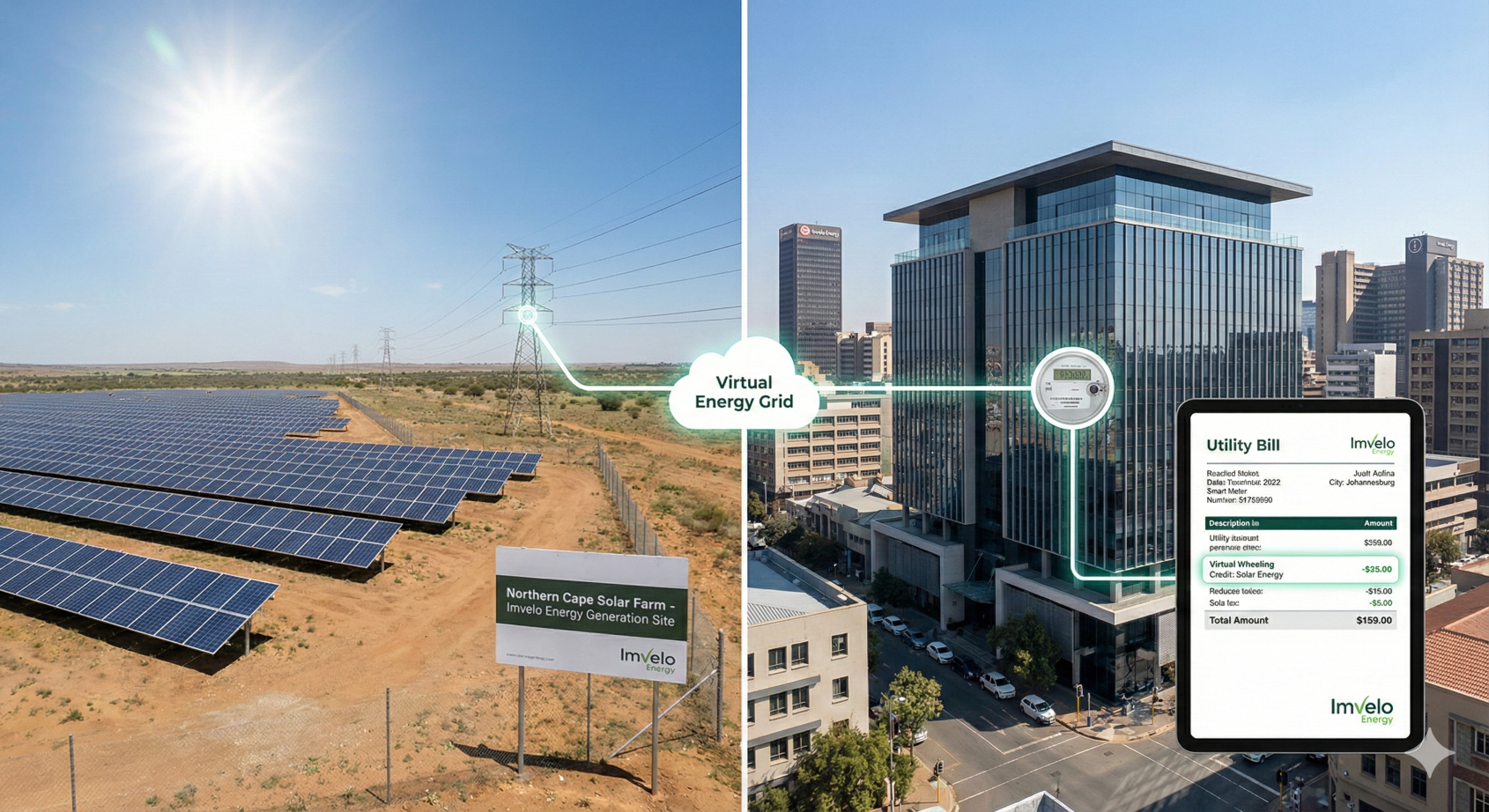
For years, South African businesses have faced a frustrating paradox: they want to adopt renewable energy to reduce costs and ensure stability, but their operational sites are often ill-suited for it. A retail chain might have hundreds of stores in shopping malls with no roof rights, or a factory might be situated in an area with poor solar irradiance.
Enter Virtual Wheeling—a mechanism that is fundamentally rewriting the rules of the national energy grid. It allows companies to generate electricity in one location and "consume" it in another, crediting the value of that power against their utility bill.
Traditionally, if you wanted solar power, you had to install panels directly on your roof. This "behind-the-meter" approach works well for single sites but fails for multi-site commercial operations or businesses in shaded, high-density areas.
Virtual wheeling decouples generation from consumption. With this model, a business can build or lease a solar plant in a high-yield area—like the sun-drenched Northern Cape—and feed that power into the national grid. Eskom or the relevant municipality tracks this injection of power and credits the business’s consumption accounts at their offices in Cape Town, Durban, or Johannesburg.
It is not a physical transfer of electrons from point A to point B, but rather a financial reconciliation. The grid acts as a virtual battery, and the utility bill becomes the ledger.
While the concept is revolutionary, the execution is complex. It requires navigating a maze of regulatory approvals, grid connection agreements, and real-time metering standards. This is where Imvelo Energy steps in as a critical enabler for commercial clients.
Imvelo Energy leverages its expertise in turn-key renewable solutions to manage the entire virtual wheeling value chain. The process generally involves three key phases:
For a commercial bank with 50 branches or a retailer with widespread logistics hubs, the benefits are transformative. Through Imvelo Energy’s virtual wheeling solutions, these businesses can now achieve 100% renewable energy coverage without installing a single panel at their branch locations.
This creates a unified energy strategy. A single, large-scale solar farm managed by Imvelo can effectively "power" a client’s entire national footprint. This not only hedges against rising tariff costs but also drastically simplifies carbon reporting, allowing businesses to meet sustainability targets with a single, verifiable green energy source.
As South Africa’s regulations continue to open up, virtual wheeling represents the future of corporate energy. It turns the national grid from a bottleneck into a business asset, allowing companies to generate power where it’s cheapest and use it where it’s needed most.


